A live operator steps in while it is happening.
Cameras detect the event, edge AI decides whether it matters, and a ULC-certified operator intervenes live with audio talk-down, a deterrence strobe and verified-alarm dispatch. Built for temporary and outdoor sites with little or no infrastructure, and billed at a flat $20 per verified event rather than by the hour.
Built for sites with nothing to plug into.
Construction sites, laydown yards, remote lots and temporary compounds, where there is no network, no power you control and no one on site after dark.
Sites with no infrastructure
Construction sites, laydown yards, remote lots and temporary compounds. Independent 5G cellular with multi-carrier failover means no trenching, no site network, and no dependency on a building you do not control.
Detection that knows what it is looking at
Edge AI discriminates people and vehicles from animals, foliage and weather. The operator sees events worth acting on rather than a night of wind-triggered noise.
Live audio talk-down
An operator speaks through the unit while the intrusion is happening. Most trespass ends at the sound of a human voice naming what the person is wearing.
Deterrence strobe
High-intensity strobe triggers automatically on detection, marking the site as actively watched before an operator says a word.
Verified alarms, not blind dispatch
An operator reviews live video before escalating. Verified alarms carry priority with police and avoid the false-alarm penalties that unverified systems accumulate.
Licence plate and facial recognition
ALPR capture with watchlist matching, and facial recognition with authorised-personnel exclusion so your own crews are not treated as intruders.
How an alarm is handled.
Follow one alarm end to end.
Most security is sold as a black box. This is the whole chain, in order. Click any step.
Detection
The camera is always watching, but it is not always alarming. Analytics on the device classify what moved: person, vehicle, loitering, line crossing. Animals, blowing foliage and weather are filtered at the edge, so an alarm leaving the site already means something with legs or wheels crossed a line you drew.
Transmission
The signal leaves over the unit's own encrypted cellular link with multi-carrier failover. It does not ride your site network, your Wi-Fi, or a phone line, so cutting power or pulling a cable at the gate does not sever the path. Loss of communication is itself reported as a trouble condition.
Verification
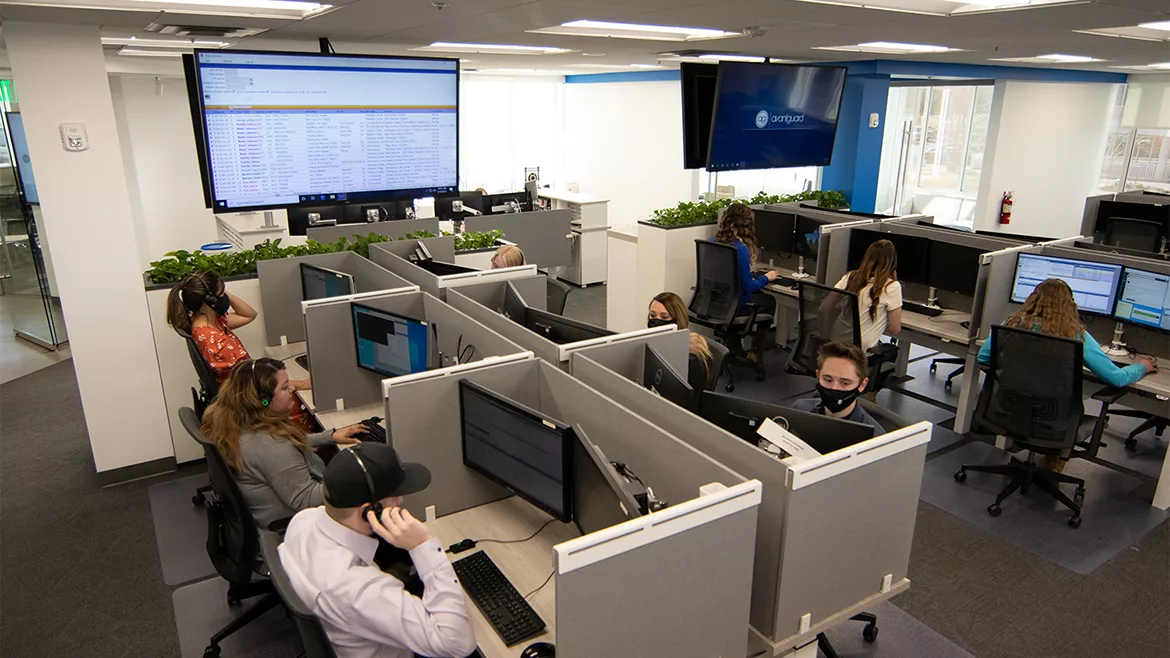
This is the step that separates us from a siren. A ULC-certified operator opens the live feed and the clip that triggered it, and looks at what is actually happening before anything escalates. No one is dispatched on a sensor's opinion.
Grading
The operator grades what they see against your site's instructions. The grade decides what happens next: note it, check with you, or dispatch. Grading is what stops a raccoon becoming a police call, and stops a break-in becoming a voicemail.
Intervention
Live audio talk-down through the unit, deterrence strobe, and where the grade warrants it, emergency services with a description of what the operator is watching in real time. On a confirmed in-progress crime, talk-down may deliberately be withheld so the subject stays put for arrival.
Record
Every action is logged with a timestamp: what was seen, who looked, what was said, who was called. You get an exportable clip and an audit trail that stands up with police, your insurer, and your own head office.
How we grade what we see.
Every verified event is assigned a threat level before anyone acts on it. The grade is what makes the response proportionate, and it is agreed with you in advance as part of your site instructions.
Power, connectivity or the camera itself is down. We do not guess. The account falls back to your written instructions and you are told the site is blind rather than left assuming it is covered.
Something triggered the alarm but there is no person or vehicle in frame. Documented and closed, with contact at the operator's discretion. You are not woken up for weather.
A person or vehicle is confirmed, but intent is not yet clear. The operator observes, follows your site instructions, and can put the video in front of your nominated contact for a fast dispatch-or-disregard call. Escalates to TL3 the moment intent becomes obvious.
Criminal activity is visible. Immediate dispatch with a live description to responders, then direct notification to your keyholder. This is the call the whole chain exists to make correctly.
Specific escalation rules, contact trees and hold times are set per site and are not published here.
From sensor to someone at the door.
What actually happens between a sensor firing and someone knocking on a door.
Who Runs This Already





In Their Words
Tell us about the site. We will show you how it would be covered.
A flat $20 per verified event, monitored from ULC-certified centres in Canada.